
Custom flexible couplings: finding the right manufacturer for OEM needs
2026-10-22 03:23
Author:
Haozong
Article overview
This guide covers how OEM procurement teams can identify, evaluate, and select the right flexible coupling manufacturer in 2026. Topics include coupling types, selection parameters, certification requirements, lead time benchmarks, and side-by-side manufacturer comparison data.
Table of contents
- 1. What makes a flexible coupling manufacturer right for OEM?
- 2. Types of custom flexible couplings and when to use them
- 3. Key selection criteria for evaluating a flexible coupling manufacturer
- 4. Certifications, quality standards, and compliance requirements
- 5. Lead times, MOQ, and supply chain considerations
- 6. How to compare flexible coupling manufacturers: a data-driven approach
- 7. Common mistakes OEM buyers make when sourcing couplings
- 8. FAQ
Finding the right coupling for an OEM assembly line is not simply a matter of matching shaft diameters on a datasheet. The coupling you choose carries torque, compensates for misalignment, and absorbs vibration — often inside a machine that runs continuously for thousands of hours. When a component fails in that environment, the cost is never just the part itself. It is downtime, warranty claims, and engineering rework. A flexible coupling manufacturer is a company that designs, produces, and validates flexible coupling assemblies capable of transmitting torque between two shafts while accommodating radial, angular, and axial misalignment. In the context of OEM procurement, the manufacturer's engineering support, customization depth, and delivery reliability matter as much as the product specification itself. The U.S. couplings market was valued at approximately $3.5 billion in 2024 and is projected to reach $5.2 billion by 2034 at a CAGR of 4.0% (Emergen Research), making supplier selection a strategically significant decision for any mechanical power transmission manufacturer or OEM buyer operating in 2026.
What makes a flexible coupling manufacturer right for OEM?
The right flexible shaft coupling supplier for OEM work is one that can deliver consistent, application-specific parts at production volumes — not just prototype quantities. That distinction matters more than most buyers initially realize.
The OEM-supplier relationship is different from standard distribution
When you source through a distributor, you are buying from catalog stock. When you partner with a custom coupling manufacturer for OEM production, you are entering a design and supply relationship. The manufacturer needs to understand your duty cycle, shaft materials, operating temperature range, and assembly tolerances — not just your bore size. In actual project reviews, engineering teams that front-load this information exchange consistently report fewer fit failures and faster qualification cycles. The supplier's willingness to assign a dedicated application engineer is often a reliable proxy for their OEM capability.
Volume commitment and tooling ownership
OEM programs often require custom bore profiles, keyways, or hub lengths that demand dedicated tooling. A capable industrial coupling company will offer clear terms on tooling ownership, amortization schedules, and minimum order quantities tied to tooling cost recovery. If a supplier cannot articulate those terms clearly, that is a red flag. Custom tooling typically requires 4–8 weeks lead time and a non-recurring engineering (NRE) cost ranging from $800 to $5,000 depending on complexity — figures that experienced procurement teams should build into their program budgets from the outset.
Types of custom flexible couplings and when to use them
Choosing the correct coupling type before approaching any jaw coupling manufacturer or disc coupling fabricator is essential. Misspecification at this stage is one of the most common — and expensive — errors in OEM mechanical design.
Flexible coupling types and core applications:
For a comprehensive reference on flexible coupling types and applications, the Wikipedia entry on flexible couplings provides a solid foundational overview of mechanical design principles.
Elastomeric and jaw-type couplings
An elastomeric coupling supplier typically offers jaw couplings (spider couplings) and tire-type designs. These use a polyurethane or rubber insert element to dampen vibration and accommodate moderate misalignment. They are the default choice in general industrial machinery, pump drives, and conveyor systems — applications where vibration absorption outweighs zero-backlash requirements. The elastomeric spider element is wear-prone and requires periodic inspection, a maintenance reality that OEM designers should account for in service interval documentation.
Disc, beam, and Oldham couplings for precision motion
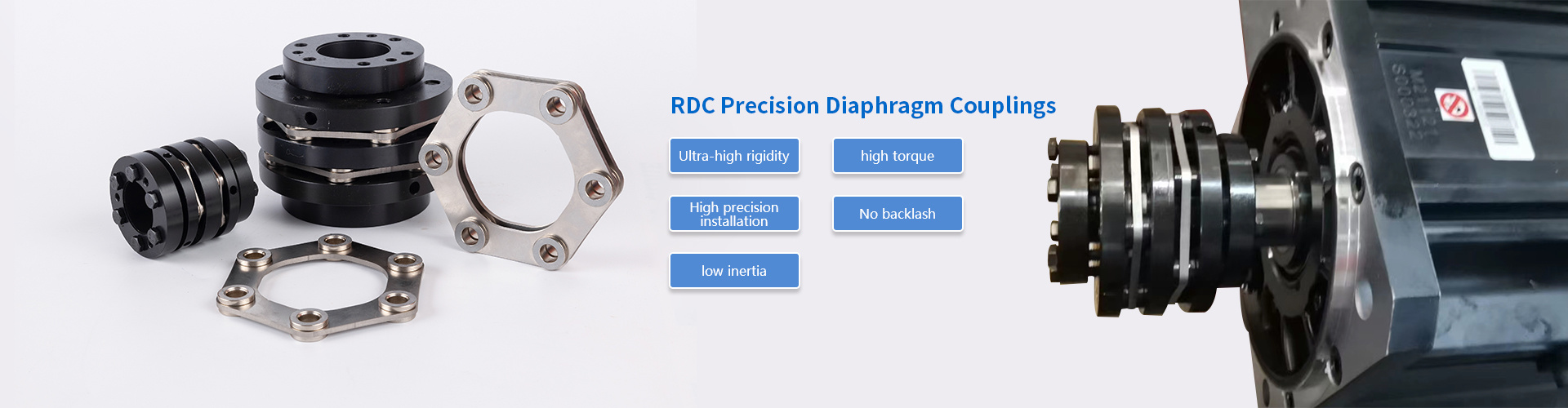
In servo and motion control applications, a beam coupling producer or disc coupling fabricator addresses a fundamentally different set of requirements. Beam (helical/spiral-cut) couplings offer zero backlash and are machined from a single piece of aluminum or stainless steel, making them compact and torsionally consistent. Disc couplings use thin metallic disc packs to transmit torque with very high torsional stiffness — a preferred configuration for precision positioning stages. An oldham coupling maker, by contrast, provides lateral misalignment compensation through a floating center disc, which suits applications where parallel offset is the primary concern. A servo coupling manufacturer must guarantee tight angular repeatability and consistent torque capacity across temperature ranges — specifications that should appear explicitly in the product data sheet, not just in marketing copy.

| Coupling type | Backlash | Vibration damping | Primary misalignment | Typical OEM use case |
|---|---|---|---|---|
| Jaw / elastomeric | Low–medium | High | Angular + radial | Pumps, conveyors, fans |
| Disc / membrane | Zero | Low | Angular + axial | Servo drives, encoders |
| Beam (helical) | Zero | Medium | All three axes | Stepper/servo motors, optics |
| Oldham | Near-zero | Medium | Parallel offset | Lead screws, actuators |
| Gear / rigid | Variable | None | None | High-torque aligned shafts |
Key selection criteria for evaluating a flexible coupling manufacturer
Once you have defined your coupling type, evaluating a shortlisted flexible coupling manufacturer comes down to a structured set of technical and commercial parameters. Here is the sequence that experienced procurement engineers follow:
- Torque capacity and safety factor — Confirm rated torque (Nm or lb·in) and peak torque capability. Industry consensus recommends a minimum 1.5× safety factor on rated torque for most industrial applications; servo applications often require 2×.
- Misalignment tolerance specification — Request quantified angular (degrees), radial (mm/inch), and axial (mm/inch) misalignment values. Vague claims like "accommodates misalignment" are not acceptable for OEM qualification documents.
- Bore range and keyway options — Verify that the manufacturer's standard bore range covers your shaft diameter, and confirm availability of clamping hubs, set-screw hubs, or custom keyway configurations.
- Material and surface treatment — Aluminum hubs dominate in motion control; steel or stainless steel is standard for high-torque industrial use. For food processing or corrosive environments, confirm coating or alloy options.
- Dynamic balancing grade — For high-speed applications (>3,000 RPM), ask for ISO 21940 balance grade certification on shipped assemblies.
- Engineering support depth — A credible coupling assembly manufacturer will offer application review, FEA reports on custom designs, and prototype validation support — not just a downloadable CAD file.
Why torque coupling supplier relationships require more than specs
Why do so many technically qualified couplings still fail in production? The answer is usually not the coupling — it is the interface. Shaft runout, bearing preload, and assembly tooling errors create misalignment conditions that exceed the coupling's rated capacity. A mature torque coupling supplier will include installation guidelines and misalignment measurement protocols in their OEM documentation package. If that documentation does not exist, you are accepting unquantified installation risk across every unit you build.
Assessing the shaft coupling vendor's manufacturing infrastructure
A visit to the facility — or at minimum a structured supplier audit — reveals what a brochure cannot. CNC turning and milling capability, dynamic balancing equipment, CMM or coordinate measuring capability, and in-house heat treatment all determine whether a shaft coupling vendor can hold the tolerances they quote. Suppliers with these assets in-house generally deliver more consistent part-to-part quality than those relying heavily on subcontractors for finishing operations.
Certifications, quality standards, and compliance requirements
For OEM programs in regulated industries, certification compliance is non-negotiable. The baseline expectation from any reputable industrial coupling company is ISO 9001:2015 quality management system certification — this confirms documented process control, traceability, and corrective action systems are in place.
Industry-specific certification requirements
Beyond ISO 9001, OEM applications in specific sectors carry additional compliance requirements. Automotive-adjacent programs frequently require IATF 16949 compliance from their precision coupling OEM partners. Aerospace applications demand AS9100D and full material traceability to AMS specifications. Food and beverage equipment requires FDA-compliant elastomer materials and NSF-approved lubricants on any sliding interfaces. These are not optional enhancements — they are qualification gates. A supplier that cannot provide the relevant certificates before contract award creates compliance liability that falls back on the OEM buyer's program.
"Misalignment is the single largest contributor to premature coupling and bearing failure in industrial drivetrain applications. Quantified misalignment limits — not general flexibility claims — must appear in every OEM supply specification." — Motion Control Tips, 2026 engineering best practices overview
RoHS and REACH compliance in 2026
With environmental compliance increasingly embedded in U.S. government procurement requirements and large OEM supplier codes of conduct, RoHS and REACH documentation for elastomeric elements and surface coatings is now a standard request in RFQ packages. Any rigid coupling producer or elastomeric coupling supplier targeting the U.S. market in 2026 should be able to provide a full materials declaration without a multi-week turnaround. Delays on this documentation often signal a supply chain with limited chemical traceability — a risk that compounds at scale.
Lead times, MOQ, and supply chain considerations
Supply chain pressure is a defining reality for OEM buyers in 2026. Raw material costs for aluminum and specialty steel alloys have risen more than 20% since 2021, and freight volatility has pushed many manufacturers to reassess offshore sourcing decisions. These structural conditions make lead time and inventory policy as critical as price per unit.
Standard vs. custom lead time benchmarks
For standard catalog items from a domestic shaft coupling vendor, typical lead times run 1–3 weeks from stock. Custom bore modifications on standard coupling bodies add 2–4 weeks. Fully engineered custom designs — new hub profiles, non-standard materials, specialized coatings — typically require 8–14 weeks including tooling and first article inspection. These timelines should be confirmed contractually, not accepted as verbal estimates. Programs that have experienced schedule compression from coupling delivery delays consistently identify the failure to specify lead time SLAs in purchase agreements as the root cause.
Near-shoring trends and domestic sourcing advantages
According to the National Association of Manufacturers, approximately 75% of U.S. manufacturers are actively increasing automation investment in 2026 — a trend that is simultaneously driving demand for precision couplings and motivating OEM procurement teams to consolidate suppliers closer to home. A domestic mechanical power transmission manufacturer can offer faster engineering iteration cycles, easier audit access, and reduced import tariff exposure. The trade-off is typically a 10–20% unit cost premium over equivalent offshore-sourced parts, a gap that narrows significantly once logistics, inspection, and risk costs are fully accounted for.
For a broader view of how to evaluate supplier capabilities and qualifications, the flexible coupling manufacturers guide on ThomasNet provides useful background on domestic supplier categories.
How to compare flexible coupling manufacturers: a data-driven approach
Side-by-side comparison is most useful when it forces quantitative evaluation rather than qualitative impressions. The table below models the kind of structured scorecard that engineering procurement teams use during supplier selection — not a ranking of specific brands, but a framework for objective evaluation.
| Evaluation criterion | Weight (%) | What to measure | Acceptable threshold |
|---|---|---|---|
| Technical specification depth | 25% | Quantified torque, misalignment, speed data | Full datasheet per SKU |
| Quality certification | 20% | ISO 9001 + industry-specific certs | Current certificate on file |
| Customization capability | 20% | Bore range, keyway, material options | In-house CNC + tooling ownership |
| Lead time reliability | 20% | On-time delivery rate (OTD) | ≥ 95% OTD over trailing 12 months |
| Engineering support | 15% | Application review, FAI, documentation | Dedicated AE assigned pre-contract |
Using first article inspection (FAI) as a qualification gate
First article inspection is the clearest signal of a manufacturer's process maturity. A capable coupling assembly manufacturer will provide dimensional reports, material certifications, and functional test results — not just a sample part. Reviewing FAI data before committing to production volumes has, in documented procurement cases, identified tolerance drift issues that would otherwise have caused assembly line rejects at scale. It is a small investment in qualification time that consistently prevents larger downstream costs.
Price benchmarking without losing quality context
Price comparisons between a precision coupling OEM and a catalog distributor are only valid when the specifications are genuinely equivalent. A $12 jaw coupling hub and a $28 hub with the same nominal bore may differ significantly in concentricity tolerance, heat treatment, and surface finish. When building a cost-down case, always request the full dimensional tolerance stack from both sources — not just the price. That said, material cost inflation in 2026 means that some price increases from established suppliers are reflecting genuine input cost changes rather than margin expansion, and buyers who understand that dynamic tend to negotiate more productively.
Common mistakes OEM buyers make when sourcing couplings
Even experienced procurement teams fall into predictable sourcing traps. Recognizing them in advance is straightforward — but correcting them mid-program is not.
Assuming flexible couplings absorb unlimited misalignment
This is the most costly misunderstanding in coupling selection. Just like a suspension bridge can flex within design limits but will fail if those limits are exceeded, a flexible coupling has rated misalignment capacity that, when surpassed, accelerates wear on the coupling element, the shaft bearings, and the seals. Real field data shows that couplings operating at even 150% of their rated angular misalignment experience element fatigue life reduction exceeding 60%. The fix is accurate shaft alignment at installation — a step that is skipped far too often in production environments under time pressure.
Prioritizing softness over stiffness in servo applications
There is a persistent misconception that softer couplings are always better because they protect the drivetrain. In servo positioning systems, excessive torsional compliance introduces phase lag between motor command and load response — which degrades positioning accuracy and can trigger servo instability. A servo coupling manufacturer optimizes for torsional stiffness first, misalignment tolerance second. Buyers specifying servo couplings should request torsional stiffness values in Nm/rad or lb·in/rad and confirm they align with the servo system's bandwidth requirements.
For detailed technical specifications and engineering data across coupling families, flexible couplings specifications on GlobalSpec offers a structured reference for procurement engineers building technical RFQ packages.
Of course, there are situations where a more flexible element is the right call — particularly in high-vibration environments where protecting downstream instrumentation justifies some loss of positional precision. The key is making that trade-off consciously, with data, rather than defaulting to one approach without evaluating the application requirements.
Choosing the right flexible coupling manufacturer: a final framework
The U.S. market for couplings is growing, automation investment is accelerating, and supply chain dynamics in 2026 are rewarding buyers who invest in deeper supplier relationships rather than purely transactional purchasing. A qualified flexible coupling manufacturer is not simply a parts vendor — they are a technical partner whose engineering depth, manufacturing consistency, and delivery reliability directly influence your product quality and production continuity.
Start with application clarity: define your torque, speed, misalignment, and environment parameters before contacting any supplier. Qualify on certifications and manufacturing infrastructure before negotiating price. Validate with first article inspection before committing to production volumes. And build the lead time and tooling terms into your contract from the start. That sequence, consistently applied, is what separates high-performing OEM programs from those that spend engineering cycles managing coupling-related field failures.
Frequently asked questions
Q: What does a flexible coupling manufacturer typically offer for OEM customization?
A: A qualified flexible coupling manufacturer offers custom bore sizing, keyway profiles, hub length modifications, non-standard materials, and specialized surface treatments. Most also provide application engineering review, first article inspection reports, and CAD model delivery to support OEM integration and documentation requirements.
Q: How do I choose between a jaw coupling manufacturer and a disc coupling fabricator for my application?
A: Choose jaw/elastomeric couplings for applications prioritizing vibration damping in general industrial or pump drives. Choose disc couplings when zero backlash, high torsional stiffness, and positional accuracy are required, such as in servo drives or encoder feedback systems. Confirm torsional stiffness values in the supplier datasheet before selection.
Q: What certifications should a precision coupling OEM supplier hold?
A: At minimum, ISO 9001:2015 quality management certification. Depending on the industry, additional requirements may include IATF 16949 for automotive-adjacent programs, AS9100D for aerospace, and RoHS/REACH materials compliance documentation. Request current certificates, not self-declarations, during supplier qualification.
Q: What are typical lead times for custom coupling orders from a domestic shaft coupling vendor?
A: Standard stock items ship within 1–3 weeks. Custom bore modifications typically add 2–4 weeks. Fully engineered designs with new tooling generally require 8–14 weeks including first article inspection. These timelines should be specified contractually with agreed on-time delivery performance metrics.
Q: Why does coupling misalignment cause early bearing failure in OEM machinery?
A: When a coupling operates beyond its rated misalignment capacity, it transmits additional radial and bending loads to the connected shaft bearings. These unintended loads exceed bearing design parameters, accelerating fatigue and reducing service life significantly. Proper shaft alignment at installation is the most effective preventive measure.
Consult immediately
If you are interested in our products, please leave your email address, and we will get in touch with you as soon as possible. Thank you!
Kunshan Haozong Transmission Technology Co., Ltd.
Contact: Manager Liu 13372152786 (WeChat)
Email: liu@hz-coupling.com
Address: Room A5-304, No. 18 Jinxing Road, Huaqiao Town, Kunshan City, Jiangsu Province

Scan the mobile website