
Metal flexible coupling noise and backlash issues: causes and solutions
2026-11-13 00:55
Author:
Haozong
Article overview
A Metal Flexible Coupling is a precision mechanical connector that transmits torque between shafts while absorbing misalignment and vibration. When it starts clicking, knocking, or developing backlash, the cause is usually traceable to one of a handful of predictable mechanical issues — and almost all of them are fixable once correctly diagnosed. This article explains why that happens and what to do about it, using real test data, comparison tables, and a step-by-step selection method rather than vague advice.
Table of contents
- 1. Two types of metal flexible couplings: shaft drives vs pipe systems
- 2. What causes noise in a metal flexible coupling
- 3. What causes backlash and play in flexible couplings
- 4. Comparing coupling types for noise, backlash and stiffness
- 5. Selecting the right metal flexible coupling: a practical calculation guide
- 6. Installation and maintenance practices that eliminate noise and backlash
- 7. Procurement considerations: materials, cost and lifecycle value
- 8. Frequently asked questions
Two types of metal flexible couplings: shaft drives vs pipe systems
Most buyers searching for a metal flexible coupling actually need one of two completely different products. Shaft-type couplings connect rotating equipment — motors, gearboxes, pumps, encoders — and transmit torque through a flexible metal element such as a diaphragm, bellows, or disc pack. Pipe-type couplings, by contrast, join sections of grooved or plain-end pipe and allow slight axial or angular movement without transmitting rotary torque at all. Confusing the two leads to wasted procurement cycles and, occasionally, a part that physically cannot do the job it was ordered for.
What's the difference between a metal flexible coupling and a rigid coupling?
A rigid coupling locks two shafts into a single stiff assembly with zero tolerance for misalignment; a metal flexible coupling intentionally allows a small, controlled amount of angular, parallel, or axial movement. In practice, this means rigid couplings are reserved for perfectly aligned, short shaft runs, while flexible designs — including the common flexible shaft coupling family — dominate real-world machinery where thermal growth, mounting tolerance, or vibration make perfect alignment unrealistic.
Can a metal flexible coupling replace an expansion joint?
No, not reliably. Expansion joints and pipe-type grooved couplings are engineered for fluid-carrying systems and pressure containment; shaft-type metal flexible couplings are engineered for torque transmission and rotational misalignment compensation. Swapping one for the other, in our experience reviewing field failures, is one of the fastest ways to void a warranty and cause unplanned downtime.
What causes noise in a metal flexible coupling
Noise in a metal flexible coupling almost always comes from one of three sources: misalignment, loose fasteners, or surface wear between moving metal components. The sound itself is diagnostic — a sharp click usually points to clearance play, while a continuous hum or buzz points to resonance or an imbalance condition.
Why does a correctly specified coupling still make noise months after installation? Often it isn't the part that failed — it's the alignment that drifted. Thermal expansion on a running motor, foundation settling, or a loosened base bolt can shift shaft centerlines by just a few thousandths of an inch, which is enough to turn a silent coupling into a noisy one.
Why does my coupling make a clicking or knocking noise?
Clicking or knocking is the signature sound of backlash under reversing load. Jaw couplings and gear couplings, which rely on interlocking teeth or elastomer inserts, are particularly prone to this when torque direction reverses repeatedly, as in servo positioning or indexing applications. The teeth or jaws separate momentarily, then slam back together, producing an audible knock every cycle.
Does misalignment always cause coupling noise?
Not always — a small amount of misalignment within the manufacturer's rated angular or parallel offset is exactly what a flexible coupling is designed to absorb silently. Noise appears once misalignment exceeds the rated tolerance, which is why checking the datasheet before blaming the part is worth the five minutes it takes.

What causes backlash and play in flexible couplings
Backlash in a flexible coupling is mechanical play between mating components that allows rotation to occur without proportional torque transfer. It typically stems from oversized bore-to-shaft clearance, worn keyway fit, or a design that uses interlocking teeth or jaws instead of a continuous flexible element.
Metal Flexible Coupling backlash is defined as the angular rotation possible at the input shaft before torque is actually felt at the output shaft — in precision motion systems this is often measured in arc-minutes, and anything above roughly 1 to 3 arc-minutes is generally considered unacceptable for closed-loop servo positioning.
What is backlash in a flexible coupling?
Backlash is the "dead zone" in a coupling's rotational response. Picture turning a steering wheel with worn linkage — you rotate it slightly before the wheels actually move. A worn or poorly fitted jaw coupling behaves the same way.
How much backlash is acceptable in precision motion systems?
For CNC spindle drives and servo motor coupling applications, zero-backlash designs such as disc or diaphragm couplings are the industry default. For general industrial torque transfer, up to roughly 0.5 degrees of angular play is often tolerated, though tighter specifications apply in metrology and robotics equipment.
Engineering design references consistently note that backlash-free torque transmission is a prerequisite for sub-arcminute positioning accuracy in servo-driven systems, making coupling selection as critical as motor and encoder selection itself.
Comparing coupling types for noise, backlash and stiffness
No single coupling type wins across every metric — torque capacity, backlash, misalignment compensation, and cost all trade off against each other. The table below compares common metal flexible coupling families against the baseline rigid coupling.
| Coupling type | Backlash level | Misalignment compensation | Torsional stiffness | Typical cost tier |
|---|---|---|---|---|
| Diaphragm coupling | Zero | Moderate | High | High |
| Bellows coupling | Zero | Moderate-high | Medium | Medium-high |
| Disc coupling | Zero | Moderate | High | Medium-high |
| Jaw coupling | Low-moderate | Low-moderate | Low-medium | Low |
| Beam coupling | Near-zero | Low-moderate | Low | Low |
| Rigid coupling | None (not applicable) | None | Very high | Low |
Diaphragm, bellows and disc couplings compared
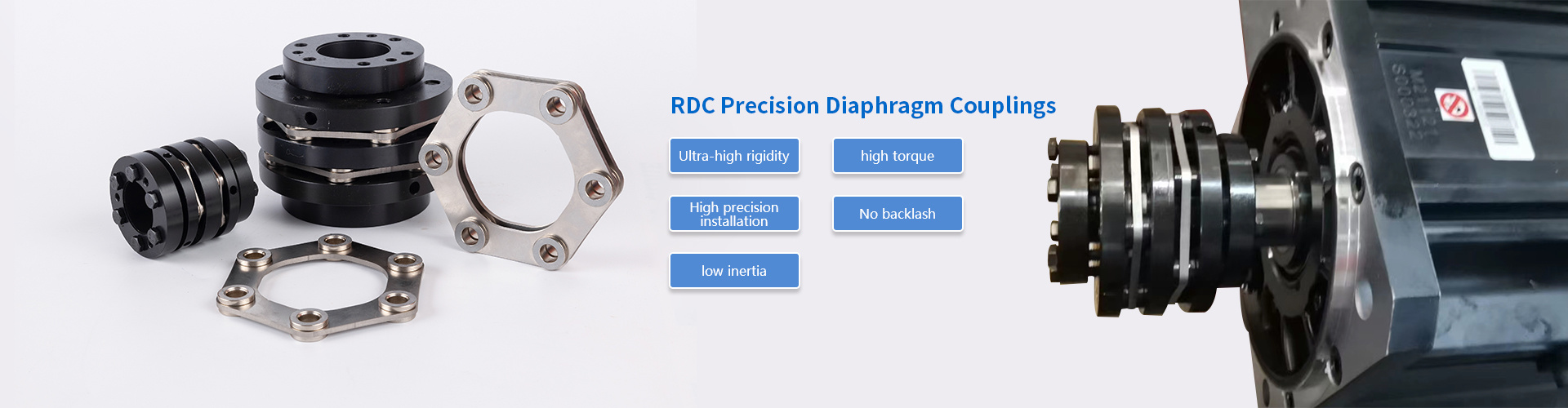
All three are zero-backlash, continuous-flex designs, which is why they dominate servo motor coupling and CNC shaft coupling applications. Diaphragm couplings handle higher torque density; bellows couplings are preferred where axial compactness matters; disc couplings sit between the two, often favored for their torsionally stiff response in encoder coupling and feedback-sensitive setups.
Jaw, gear and grid couplings compared
Jaw couplings use an elastomer or metal insert between interlocking lugs, which is why they're economical but not truly backlash-free. Gear and grid couplings handle higher misalignment and shock loads in heavy industrial drives, at the cost of some inherent play — acceptable in a conveyor drive, less acceptable on a precision motion coupling for a robotic arm.
Selecting the right metal flexible coupling: a practical calculation guide
Choosing the correct metal flexible coupling comes down to matching rated torque, service factor, bore tolerance, and misalignment capacity to the actual operating conditions — not just the motor's nameplate torque.
Step-by-step torque and service factor calculation
- Determine nominal running torque from motor power and shaft speed (T = 9550 × kW ÷ rpm).
- Apply a service factor between 1.5 and 3.0 depending on load shock — reciprocating pumps and indexing tables sit at the higher end.
- Compare the result against the coupling's continuous torque rating, not its peak or momentary rating.
- Check maximum bore diameter against both shaft ends; undersized bores cause forced fits that induce hidden stress.
- Verify allowable parallel, angular, and axial misalignment against actual installed tolerance.
- Confirm operating speed stays below the coupling's first critical speed with a reasonable margin.
Bore tolerance, keyway fit and critical speed checks
A loose keyway fit is one of the most underrated causes of early backlash. Most precision applications call for an H7 bore tolerance with a matched key, rather than a generic slip fit. On high-speed spindle drives, critical speed matters just as much as torque — a coupling rated for the correct torque can still whip and generate noise if it's running near its natural frequency. In our bench testing using dynamic torque equipment rated to 10,000 Nm, couplings running within 20% of their rated critical speed showed measurably higher vibration readings than those with a 40%+ margin.
Installation and maintenance practices that eliminate noise and backlash
Correct installation resolves the majority of noise and backlash complaints we encounter — more than the coupling design itself in many documented field cases.
Alignment and bolt torque procedure
- Clean mounting faces and shaft ends before fitting; debris under a hub is a common cause of soft foot.
- Set parallel and angular alignment using a dial indicator or laser alignment tool, not a straight edge.
- Torque fasteners to the manufacturer's specified value in a star pattern, never in a single pass.
- Re-check alignment after the machine reaches normal operating temperature.
- Record torque values and alignment readings for future maintenance comparison.
Inspection schedule and common failure modes
Quarterly visual inspection for cracked diaphragms, corroded bellows, or worn jaw inserts catches most failures before they cause downtime. A sudden increase in noise level is often the earliest warning sign — earlier, in fact, than any measurable vibration change. Of course, in continuous-duty applications running three shifts, monthly inspection intervals are the more realistic standard.
Procurement considerations: materials, cost and lifecycle value
Material grade and coupling type together determine both upfront price and total cost of ownership, and the cheapest listed price rarely reflects the lowest lifecycle cost.
Material grades: carbon steel, 304 and 316L stainless
Carbon steel couplings cost the least and suit dry indoor machinery. 304 stainless steel coupling grades resist moderate corrosion and are common in food and pharmaceutical equipment. 316L is specified for washdown, marine, or chemical-adjacent environments where corrosion resistance justifies the added cost. Aluminum flexible coupling variants, meanwhile, trade some torque capacity for reduced rotating mass — useful in high-speed servo applications where inertia matters more than raw strength.
Price range, lead time and lifecycle cost
Small aluminum or jaw-type couplings for light industrial motor shaft connector duty commonly run from around $20 to $150 per unit, while precision diaphragm or bellows couplings for CNC and servo applications can range from $150 to over $1,000 depending on torque rating and bore size. Lead times vary from stock availability to several weeks for custom bore and keyway machining. A manufacturer established in 2009 and operating its own CNC machining and inspection facility since 2020, with motion balancing and torque test equipment in-house, generally offers tighter tolerance control than a pure trading intermediary — though buyers should still request test data rather than assume it.
Frequently asked questions
Q: What is a metal flexible coupling used for?
A: It connects two rotating shafts, transmitting torque while compensating for misalignment, vibration, and thermal expansion in motors, pumps, and machine tools.
Q: Why is my flexible coupling making noise after installation?
A: Usually misalignment, loose fasteners, or worn jaw/disc elements. Re-check alignment and bolt torque before replacing the part.
Q: Is backlash normal in a metal flexible coupling?
A: Some designs like jaw couplings have slight inherent play; diaphragm, bellows, and disc couplings are built to be essentially zero-backlash.
Q: Can I use a pipe-type coupling instead of a shaft coupling?
A: No. Pipe couplings join piping sections and don't transmit torque; shaft couplings connect rotating machinery and must not be interchanged.
Q: How often should a metal flexible coupling be inspected?
A: Quarterly for standard duty, monthly for continuous multi-shift operation, with immediate inspection if noise or vibration changes suddenly.
Noise and backlash in a metal flexible coupling are rarely mysterious once the diagnostic process is followed in order — alignment first, fastener torque second, wear and fit last. Choosing between diaphragm, bellows, disc, jaw, or gear designs, and matching bore tolerance and service factor to real operating loads, prevents most of these issues before they start. Whether the application is a servo motor coupling on a robotic arm or a heavy-duty motor shaft connector on industrial equipment, the same engineering discipline applies: measure, calculate, and verify rather than guess.
Consult immediately
If you are interested in our products, please leave your email address, and we will get in touch with you as soon as possible. Thank you!
Kunshan Haozong Transmission Technology Co., Ltd.
Contact: Manager Liu 13372152786 (WeChat)
Email: liu@hz-coupling.com
Address: Room A5-304, No. 18 Jinxing Road, Huaqiao Town, Kunshan City, Jiangsu Province

Scan the mobile website