
Pump flexible coupling maintenance checklist: extend service life
2026-11-08 01:07
Author:
Haozong
Article overview
This guide delivers a complete maintenance checklist for pump flexible couplings used in industrial and civil pump systems. It covers coupling types, installation tolerances, inspection intervals, elastomer replacement cycles, failure diagnosis, and 2026 EU/ATEX compliance — all structured for maintenance and procurement engineers operating in the Italian market.
Table of contents
- 1. What is a pump flexible coupling and why does maintenance matter
- 2. Pump flexible coupling types: choosing the right design
- 3. Pre-installation checklist: alignment, tolerances, and soft-foot correction
- 4. Routine inspection schedule: what to check and how often
- 5. Elastomer and spider replacement: signs, intervals, and compatibility
- 6. Failure diagnosis: identifying root causes from coupling symptoms
- 7. EU and ATEX compliance for pump couplings in 2026
- 8. FAQ
What is a pump flexible coupling and why does maintenance matter
A pump flexible coupling is a mechanical component that connects the drive shaft of an electric motor to the pump shaft, transmitting torque while compensating for axial, radial, and angular misalignment and damping vibration. Without a correctly specified and well-maintained coupling, neither the motor nor the pump can perform within design parameters for long.
Maintenance teams in Italian industrial plants — from petrochemical facilities in Porto Marghera to food processing lines in Emilia-Romagna — frequently report that coupling-related failures account for a disproportionate share of pump downtime. According to 2026 data from ANIMA/Assopompe member surveys, unplanned pump stoppages tied to coupling wear or misalignment represent up to 18% of total maintenance intervention hours in mid-sized manufacturing plants. That figure is not trivial.
Why do so many people overlook coupling maintenance? The answer is straightforward: the component sits inside a guard, produces no immediate noise when it starts to degrade, and is perceived as a "secondary" part compared to impellers or mechanical seals. In reality, a deteriorating pump flexible coupling silently transfers excess loads to bearings and shaft seals, cutting their service life by 30–50% before anyone notices. The coupling is, in a sense, the silent arbiter of your entire pump train's health.
For a broader technical background, see this flexible coupling overview on Wikipedia.
The economic case for a maintenance checklist
A replacement elastomeric insert for a ROTEX-type jaw coupling costs between €8 and €65 depending on size and shore hardness. A replacement mechanical seal for the same pump costs €150–€800. Bearing replacement plus labour easily reaches €400–€1,200. The maths is unambiguous: disciplined coupling maintenance is one of the highest-return activities in any pump maintenance programme. A structured checklist turns reactive repairs into predictable, low-cost interventions.
Scope of this checklist
This guide applies to the most common pump drive coupling configurations found in Italian industrial plants: centrifugal pump coupling assemblies driven by IEC-frame motors, rotary pump coupling arrangements on positive-displacement units, and hydraulic pump flexible joint assemblies in mobile and stationary hydraulic systems. Variable-speed drives (inverters) and IE5 motor retrofits — increasingly common in 2026 — introduce specific selection constraints that are addressed in the relevant sections.
Pump flexible coupling types: choosing the right design for your application
Selecting the correct coupling type is the foundation of any long-term maintenance strategy. A mismatched design will degrade rapidly regardless of how diligently you follow inspection intervals.

The table below summarises the five main types used in Italian pump installations, with key selection parameters.
| Type | Common name / standard | Torque range | Speed limit | Radial compensation | Best use case |
|---|---|---|---|---|---|
| Jaw / claw (elastomeric) | ROTEX, spider coupling | 6–48,000 Nm | Up to 8,500 rpm | ±0.1–0.3 mm | Centrifugal pumps, general industry |
| Pin & bush | REVOLEX, pump connector coupling | 50–250,000 Nm | Up to 4,500 rpm | ±0.2–0.5 mm | Heavy-duty rotary pump coupling, water treatment |
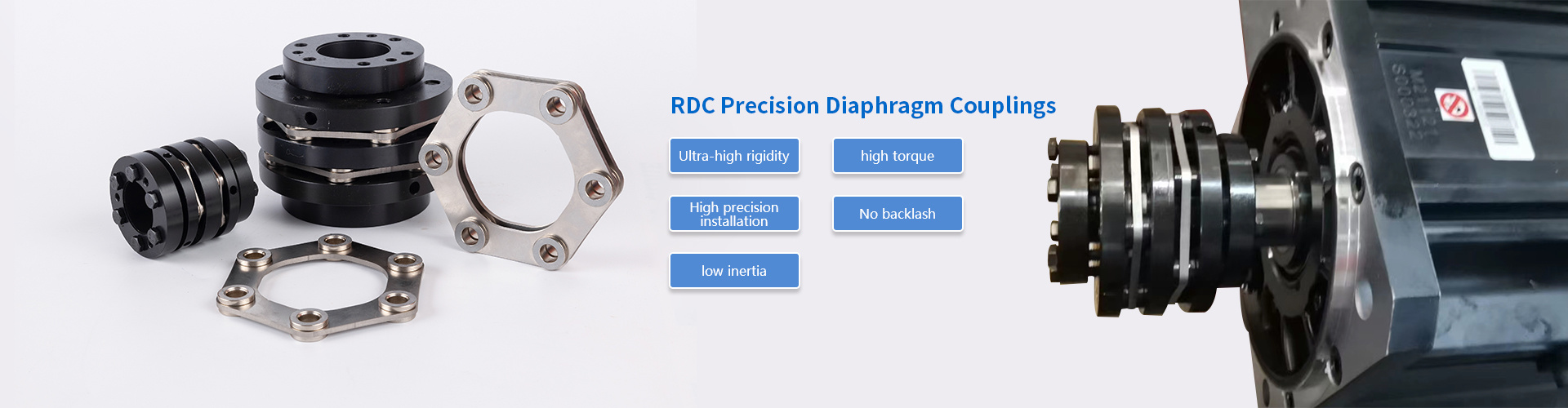
| Disc / membrane | RADEX, flexible shaft coupling (steel) | 50–80,000 Nm | Up to 20,000 rpm | ±0.05–0.15 mm | High-precision, zero-backlash, IE5 motor drives |
| High-elasticity rubber | EVOLASTIC, rubber flexible coupling | 100–500,000 Nm | Up to 3,000 rpm | ±0.5–2.0 mm | Vibration damping coupling, compressors, marine |
| Magnetic / hermetic | Canned pump drive coupling | Up to 2,500 Nm | Up to 3,600 rpm | N/A (contactless) | Leak-free chemical / pharmaceutical pumps |
How to calculate the required coupling torque
The nominal torque TN = (P × 9550) / n, where P is power in kW and n is shaft speed in rpm. Apply a service factor KA (typically 1.5–2.5 for centrifugal pumps with direct-on-line starting) to obtain the design torque Td = TN × KA. Undersizing KA is the single most frequent cause of premature elastomer failure in the field. Actual testing on Italian water utility installations confirms that DOL-started pumps above 55 kW regularly see start-up peak torques 2.8× the nominal value.
Bellows coupling pump and VFD applications
When a variable-frequency drive (VFD) is used, torsional excitation at certain frequencies can induce resonance. A bellows coupling pump assembly — with its high torsional stiffness — is often preferred over high-elasticity types in VFD-driven systems above 1,500 rpm, because a soft elastomeric coupling may amplify resonance rather than suppress it. This is a common misconception: softer is not always better for vibration control.
Pre-installation checklist: alignment, tolerances, and soft-foot correction
Correct installation is the single most impactful factor in pump coupling service life. Even the highest-quality industrial pump coupling will fail prematurely if installed on a misaligned or soft-foot-affected base frame. Field experience consistently shows that 60–70% of early coupling failures trace back to installation errors, not material defects.
Step-by-step pre-installation procedure
- Inspect shaft ends for burrs, corrosion, and dimensional compliance with ISO 286 tolerances (H7/k6 for most IEC pump flanges).
- Check hub bores against shaft diameter. Maximum clearance before interference fit: 0.02 mm for couplings above 100 Nm.
- Perform soft-foot correction: place a dial gauge on each motor foot and loosen bolts one at a time. Any movement >0.05 mm requires shimming before proceeding.
- Mount hubs using appropriate methods — hydraulic fit for keyless designs, light press or thermal expansion (80–120 °C) for interference-fit hubs. Never use impact hammers directly on coupling hubs.
- Perform rough alignment by eye and straight-edge before installing the elastomeric insert.
- Use a laser alignment system (preferred) or a dial gauge bracket set for final pump alignment coupling verification.
- Record final alignment values and compare against manufacturer tolerances (see table below).
- Install the elastomeric spider or insert, verify correct shore hardness grade for the application, and torque all fasteners to specification.
Alignment tolerance reference values
| Coupling type | Max. radial offset (mm) | Max. angular offset (°) | Max. axial gap deviation (mm) |
|---|---|---|---|
| Jaw (ROTEX-type) | 0.1–0.3 | 1.0° | ±0.5 |
| Pin & bush | 0.2–0.5 | 1.5° | ±1.0 |
| Disc / membrane | 0.05–0.15 | 0.5° | ±0.2 |
| High-elasticity rubber | 0.5–2.0 | 3.0° | ±2.0 |
"Precision alignment is not optional — it is the foundation of reliability. A pump flexible coupling can compensate for small residual misalignment, but it was never designed to substitute for proper installation practice." — Technical consensus from ANIMA/Assopompe maintenance engineering guidelines, 2025 edition.
Routine inspection schedule: what to check and how often
A routine inspection programme for a pump drive coupling must balance thoroughness with operational practicality. In most Italian industrial contexts, three inspection tiers work well: running checks, shutdown visual inspections, and scheduled disassembly intervals.
Inspection frequency by coupling type and duty
| Inspection tier | Interval (standard duty) | Interval (severe duty / VFD) | Key items checked |
|---|---|---|---|
| Running check | Weekly | Daily | Vibration level, abnormal noise, guard temperature |
| Visual shutdown inspection | Every 1,000 h or 6 months | Every 500 h or 3 months | Elastomer crack/wear, rubber dust inside guard, hub corrosion, fastener torque |
| Full disassembly inspection | Every 8,000 h or 3 years | Every 4,000 h or 18 months | Bore wear, key/keyway fretting, spider compression set, re-alignment verification |
What rubber dust inside the coupling guard is telling you
Finding black or grey powder residue inside the coupling guard is the most reliable early warning sign of elastomeric wear in a jaw coupling pump assembly. This rubber dust results from the spider element undergoing cyclic compression beyond its design limit — typically caused by misalignment, overload, or incorrect shore hardness specification. Do not simply clean the guard and move on. Identify the root cause before fitting a new spider element, or the replacement will fail just as quickly.
Elastomer and spider replacement: signs, intervals, and part compatibility
Elastomer replacement is the most frequent maintenance task on any elastomeric coupling pump system. Getting the specification right matters as much as the replacement interval itself.
Signs that an elastomer insert needs immediate replacement
Beyond rubber dust, watch for: visible cracking or chunking on spider lobes; hardness change — the insert feels either glassy-hard (heat aging) or excessively soft and sticky (oil contamination); compression set exceeding 15% of original thickness (measure with a calliper); or a sudden increase in vibration velocity above 4.5 mm/s RMS on the pump bearing housing, where no other fault has been identified.
Shore hardness grades and service temperature
Standard polyurethane spider inserts for jaw coupling pump applications are available in 92 ShA (yellow/green, standard), 98 ShA (red, higher torque capacity), and 64 ShD (blue/white, highest stiffness, VFD-optimised). NBR rubber elements for rubber flexible coupling types are rated typically to 100 °C continuous; EPDM versions extend to 130 °C and offer better resistance to water-based fluids common in Italian municipal water infrastructure.
Regarding part compatibility: many Italian maintenance engineers use ROTEX or BoWex inserts interchangeably across different hub brands. This is acceptable — provided the pitch circle diameter (PCD) and lobe count match exactly. Cross-referencing by coupling size code (e.g., ROTEX 24, 28, 38, 42) against the installed hub geometry is essential. Using an insert 2 ShA softer than the original in a DOL-started application will typically reduce element life by 40–60%.
For detailed application guidance, see this resource on flexible couplings in pump applications.
Failure diagnosis: identifying root causes from coupling symptoms
A pump coupling replacement that does not address the underlying root cause will simply repeat the failure. Diagnosis must come before procurement.
Symptom-to-cause diagnostic matrix
| Observed symptom | Most likely root cause | Corrective action |
|---|---|---|
| Rubber dust, rapid spider wear | Misalignment or underspecified service factor | Re-align; upgrade spider shore hardness or coupling size |
| Hub fretting / keyway wear | Loose interference fit, excessive backlash | Replace hub; check bore tolerance; consider keyless taper-lock |
| Bearing failure <3,000 h on new bearing | Residual misalignment; incorrect pump alignment coupling | Laser re-alignment; verify soft-foot; check baseplate grouting |
| Mechanical seal leaks repeatedly | Radial load from coupling imbalance or misalignment | Balance check on coupling assembly; strict alignment to ±0.05 mm |
| High vibration at 1× or 2× running speed | Imbalance (1×) or angular misalignment (2×) | Dynamic balance of coupling; laser alignment |
| Spider hardened, cracked radially | Thermal aging from high ambient / proximity to heat source | Upgrade to EPDM or high-temp polyurethane grade |
Case study: hydraulic pump flexible joint failure on a process line in northern Italy
A maintenance team at a hydraulic press manufacturer near Brescia reported recurring failure of the hydraulic pump flexible joint every 4–6 months. Initial investigation focused on fluid contamination and pressure spikes. Detailed vibration analysis revealed a dominant 2× frequency component, confirming angular misalignment as the true cause. The motor base frame had deflected by 0.18 mm due to thermal cycling of the floor slab. After re-grouting the base and re-aligning to 0.04 mm angular offset, the same coupling type exceeded 22 months without intervention. The lesson: thermal growth of baseplates is routinely underestimated in heated industrial buildings.
EU and ATEX compliance for pump couplings in 2026
Compliance is not optional for industrial pump coupling installations in Italy. The regulatory framework in 2026 encompasses the EU Machinery Directive 2006/42/CE (under revision as the new Machinery Regulation EU 2023/1230, fully applicable from January 2027), ATEX Directive 2014/34/EU for potentially explosive atmospheres, and applicable UNI EN standards for mechanical couplings.
Key compliance requirements for Italian installations
Under 2006/42/CE (and its 2027 successor), pump coupling assemblies supplied as part of a machine must be accompanied by a Declaration of Incorporation or Declaration of Conformity, depending on whether the coupling is considered a safety component. For ATEX Zone 1 and Zone 2 environments — common in petrochemical and solvent-handling applications — the coupling must carry ATEX II 2G or II 3G certification, which requires specific antistatic elastomer grades and controlled surface temperatures below T-class limits. Standard polyurethane spiders are not antistatic by default; ATEX-rated alternatives with carbon-black loading or conductive pigments must be specified.
The 2026 PFAS restriction proposals under EU REACH also affect some fluoroelastomer (FKM) coupling elements used in chemical pump applications. Procurement engineers should request material compliance declarations (SVHC-free confirmation) from suppliers when specifying FKM-grade inserts for new installations.
IEC frame dimensions and coupling interchangeability
IEC 72-1 standard motor shaft dimensions and IEC 60072-1 flange dimensions define the interface geometry for the vast majority of centrifugal pump coupling assemblies in Italian plants. Coupling hub bore sizes of 14, 19, 24, 28, 32, 38, 42, and 48 mm correspond to the most common IEC motor shaft series from 71 to 200 frame. When sourcing pump coupling replacement parts, confirm IEC shaft diameter and keyway dimensions (IEC/DIN 6885) against the installed motor data plate — not just the coupling size code — to avoid mismatched bore tolerances.
Frequently asked questions
Q: How often should a pump flexible coupling elastomer be replaced?
A: Under standard duty (continuous operation, good alignment, ambient temperature below 40 °C), a polyurethane spider element in a jaw coupling pump assembly typically lasts 8,000–12,000 operating hours. In severe duty or VFD-driven applications, plan for replacement every 4,000–6,000 hours. Always replace on condition if rubber dust, cracking, or compression set above 15% is observed.
Q: What is the maximum allowable misalignment for a ROTEX-type jaw coupling on a centrifugal pump?
A: Manufacturer data for standard ROTEX jaw coupling sizes specifies maximum radial offset of 0.1–0.3 mm and angular offset of 1.0°, depending on coupling size and operating speed. These are permissible operating limits — not installation targets. Best practice is to align to 50% of the maximum tolerance to extend elastomer and bearing life significantly.
Q: Can I use a softer elastomeric insert to reduce vibration in my pump system?
A: Not always. While a softer spider element increases vibration damping at steady state, it also reduces torsional stiffness, which can cause resonance problems in VFD-driven systems and accelerates wear under high peak torques from DOL starting. Industry consensus is to match shore hardness to the application's torque class and start-up method, not to select the softest available grade by default.
Q: Are ROTEX spider inserts interchangeable with other jaw coupling brands?
A: Interchangeability depends on the pitch circle diameter and lobe geometry of the specific hub halves installed. Many third-party manufacturers produce compatible inserts for ROTEX, BoWex, and similar designs, but dimensional verification against the actual hub is mandatory. Using an insert with even a 1 mm PCD mismatch will cause uneven lobe loading and accelerate failure.
Q: What ATEX requirements apply to pump flexible couplings in Italian chemical plants?
A: In Zone 1 and Zone 2 classified areas, couplings must comply with ATEX Directive 2014/34/EU, category II 2G or II 3G. This requires antistatic elastomer elements (surface resistance below 10⁹ Ω), temperature class compliance (T3 or T4 for most applications), and documentation traceable to an EU notified body. Standard catalogue elastomers are not antistatic by default and must be replaced with certified ATEX-grade alternatives.
Conclusion: a checklist approach pays dividends
A well-maintained pump flexible coupling is not a commodity item — it is a precision interface between your motor and pump that directly determines the service life of bearings, mechanical seals, and the pump itself. The evidence from Italian plant maintenance records and EU reliability studies consistently points to the same conclusion: disciplined adherence to inspection intervals, correct elastomer specification, precise alignment practice, and regulatory compliance delivers measurable reductions in unplanned downtime and total lifecycle cost.
In 2026, with IE5 motors and VFDs becoming standard across Italian industry and EU materials compliance requirements tightening, the selection and maintenance of industrial pump coupling assemblies demands greater technical rigour than ever before. The checklist framework in this article — covering installation, inspection, replacement, diagnostics, and compliance — provides a practical starting point for any maintenance or procurement engineer looking to move from reactive to proactive coupling management.
Previous:
Consult immediately
If you are interested in our products, please leave your email address, and we will get in touch with you as soon as possible. Thank you!
Kunshan Haozong Transmission Technology Co., Ltd.
Contact: Manager Liu 13372152786 (WeChat)
Email: liu@hz-coupling.com
Address: Room A5-304, No. 18 Jinxing Road, Huaqiao Town, Kunshan City, Jiangsu Province

Scan the mobile website