
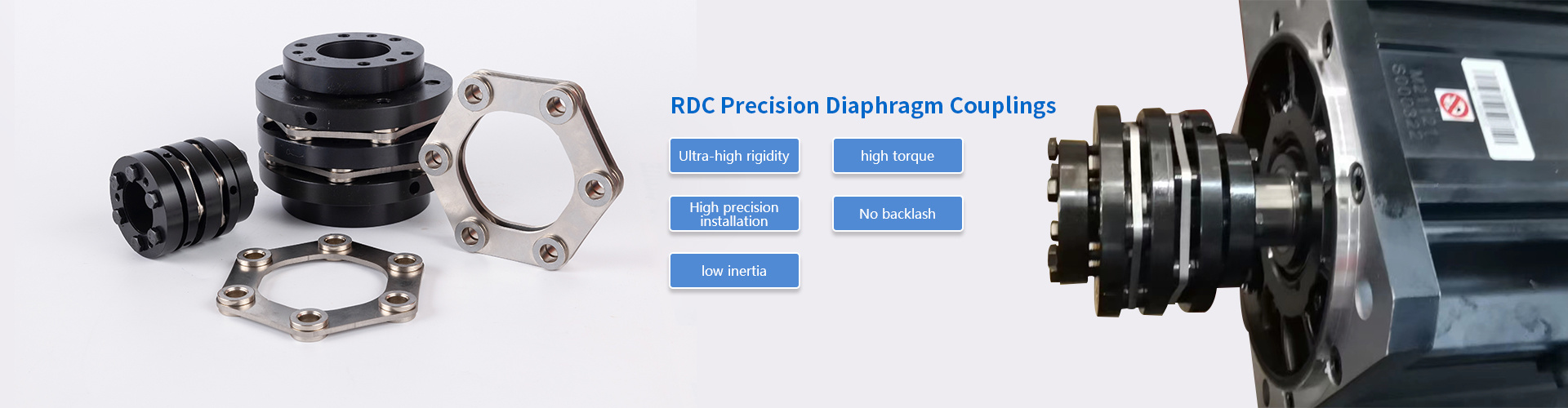
Several precautions when adjusting and aligning the diaphragm coupling
2022-06-25 08:39
1. If the concentricity of the diaphragm coupling is detected before the anchor bolts are tightened, it is not necessary to rush to remove the measuring tool after adjustment. Because in the process of tightening the anchor bolts, due to improper tightening methods or the lack of support of the shim near the anchor bolts, the installation accuracy will change after tightening. Generally, it is required to check again after tightening, or check while tightening to ensure the concentricity of the two axes.
2. When installing on site, due to the limitation of conditions, most of the pads used for level adjustment are iron plates of different thicknesses. When using, be sure to remove the burrs, welding slag and other debris on the edge of the iron plate to prevent the debris from being broken due to vibration and other reasons after the adjustment of each part, the support of the horn is not strong, the parts sinking or The change of position will change the concentricity of each diaphragm coupling, resulting in the equipment installation accuracy not meeting the requirements. Generally, after the adjustment meets the requirements, the pad iron is welded into one.
3. When installing, first install the drum components, and then use the drum spindle as the reference axis to measure the concentricity between the output shaft of the reducer and the drum spindle. After the components of the reducer are adjusted to meet the requirements, use the input shaft of the reducer as the reference axis to measure the concentricity of the motor shaft. However, because the brake wheel diaphragm coupling is installed on the input shaft of the reducer, both the motor and the brake are installed on the motor base. Before adjusting the motor shaft, first use the table of the brake wheel as the benchmark, adjust the brake shoe on the brake, and then adjust the concentricity of the motor shaft and the input shaft of the reducer.
When the torque is enough to overcome the conveying load, the turbine starts to rotate and drives the conveyor to run through the reducer. The slip of the diaphragm coupling under rated torque is 3%~5%. That is, the efficiency of the diaphragm coupling is 97%~95%. When the blower is overloaded, the load on the turbine increases, the speed of the turbine decreases, and the circulation increases, resulting in negative pressure at the annular gap between the turbine and the inner edge of the pump wheel, reducing the pressure in the rear auxiliary chamber. Therefore, the oil flows back into the rear auxiliary chamber through the small hole on the pump wheel, which reduces the transmission torque at low speed and achieves the purpose of overload protection.
Kunshan Haozong Transmission Technology Co., Ltd.
Contact: Manager Liu 13372152786 (WeChat)
Email: liu@hz-coupling.com
Address: Room A5-304, No. 18 Jinxing Road, Huaqiao Town, Kunshan City, Jiangsu Province

Scan the mobile website