
What is the maximum temperature a diaphragm coupling can withstand?
2022-06-25 08:50
Diaphragm couplings are widely used, especially in harsh environments, they can still be used normally, so many customers want to know, what is the highest temperature the diaphragm coupling can withstand?
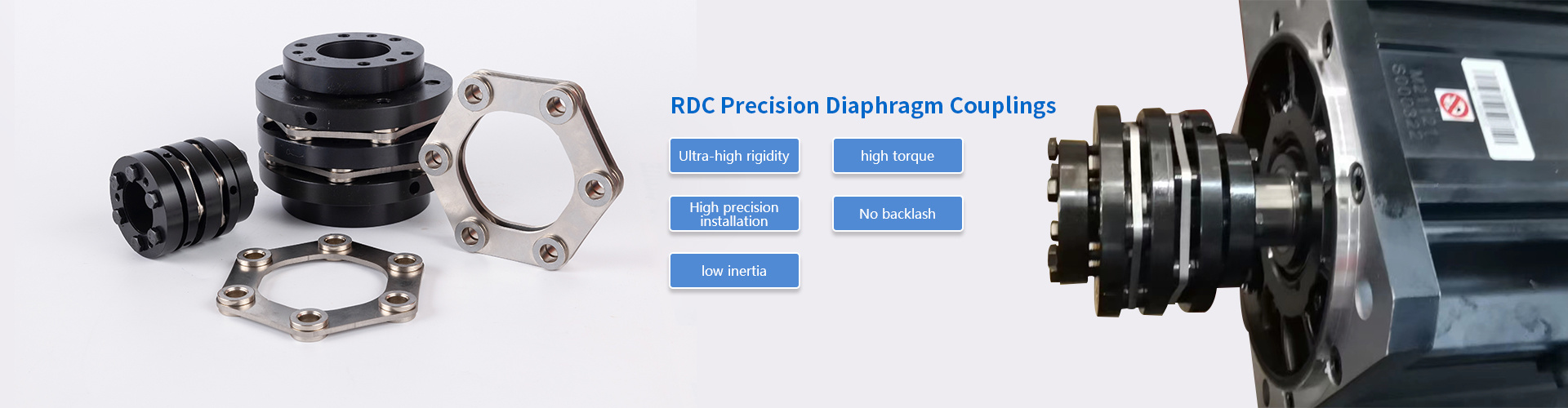
The diaphragm of the diaphragm coupling is pinned to the shaft sleeve and generally does not loosen or cause recoil between the diaphragm and the shaft sleeve. This characteristic is a bit like a bellows coupling. In fact, the coupling transmits Torque is pretty much the same way. The diaphragm itself is thin, so it flexes easily when relative displacement loads are created, so it can tolerate up to 1.5 degrees of deflection while producing low bearing loads in the servo. Diaphragm coupling can adapt to high temperature (-80+300) and work in harsh environment, and can act under shock and vibration conditions.
Diaphragm couplings are very delicate and can be easily damaged if misused in use or not installed correctly. Therefore, it is very moderate to ensure that the deviation is within the bearing range of the normal operation of the coupling. Diaphragm coupling has a wide range of applications, but the quality of the diaphragm coupling is the key to affecting the transmission torque, cost and service life of the coupling. There are quite a lot of them. Strictly implement the standard to manufacture precise diaphragm couplings, so that the cost performance (performance and price comparison) of the couplings are well received by actual users. Let us introduce how the diaphragm couplings are precisely manufactured:
Diaphragm coupling parent body manufacturing. The selection of the parent material of the diaphragm coupling is very important. Generally, 45# or 40CR forging material should be selected and roughed after normalizing treatment. After roughing, it should be quenched and tempered to ensure the integrity of the coupling material. When the mechanical properties reach their performance state, finishing is carried out after quenching and tempering treatment. After finishing, a mechanical dynamic balance test is required. The very important diaphragm coupling is also subjected to nitriding treatment to ensure the transmission strength of the coupling parent body.
In addition, it is the selection and manufacture of the diaphragm material. The diaphragm material should have high strength and fatigue, as well as good processing performance, corrosion resistance and heat resistance. At present, high-strength alloys such as 1CR18NI9, 1CR18NI9TI and other stainless steels are mainly used. production.
However, because the difference of diaphragm material directly affects the performance, service life and use cost of the diaphragm coupling (frequently changing the diaphragm), and the price of the diaphragm material varies greatly, the equivalent diaphragm coupling on the market is It is made of cheap materials.
Furthermore, the bolts of the diaphragm coupling should be connected with high-strength bolts of grades 8, 8 and 10, 9 or even 12, 9 to ensure that the coupling needs to transmit torque.
Kunshan Haozong Transmission Technology Co., Ltd.
Contact: Manager Liu 13372152786 (WeChat)
Email: liu@hz-coupling.com
Address: Room A5-304, No. 18 Jinxing Road, Huaqiao Town, Kunshan City, Jiangsu Province

Scan the mobile website