
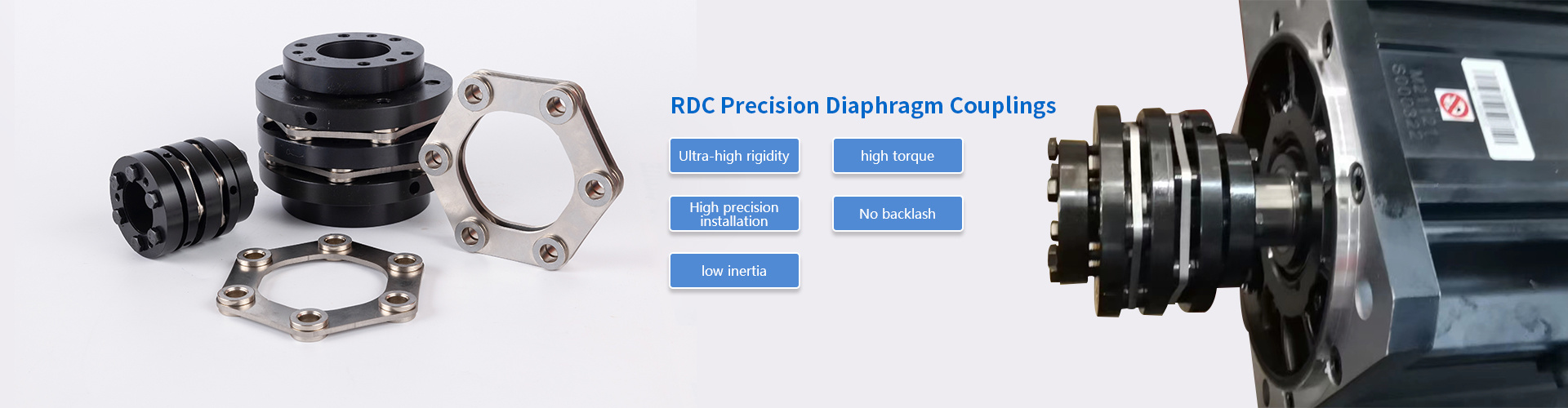
How to choose a coupling
2022-06-25 08:45
How to use the coupling that connects the rotary shaft is really different. And our manufacturer has produced various corresponding couplings around these usage methods.
In the past, gears and conveyor belts were the main methods of rotary transmission, but now, the use of couplings is more and more extensive, and the types and types of use are also increasing
On the other hand, it is not uncommon for the device to fail due to the breakage of the coupling, resulting in significant damage. Sometimes the slewing system of the device will bear an unexpectedly large load, therefore, it must be selected carefully and pay attention to improve the safety rate.
The amount of energy to be transmitted (torque, rotational speed, inertia of the rotating body, etc.), the reversal frequency and its instantaneous rotational angular acceleration, the type and size of the inter-axle deviation (refer to Fig. 1), the space, and the environment (water, oil, Conditions such as light, electromagnetic waves, dust, ambient temperature, vacuum, etc.), the required rotation life... It is necessary to select items that meet the needs from these items and that are priced appropriately.

If it is damaged within a short time after actual use, it is caused by excessive torque or deviation. In particular, servo motors often fail. Among them, the biggest problem is the misunderstanding that the servo motor should not have a torque exceeding the instantaneous maximum (3 times) torque applied to the coupling.
(Fig. 2) Taking the program control between point A ⇔ point B as an example, it shows the comparison between the drive current waveform of the servo motor and the servo gain. At point A and point B of starting and stopping, the motor flows the instantaneous maximum current, and between A→B, even if the gyrator is running at low speed, the gyrator will still vibrate.
Since the gyrator and the shaft of the servo motor have a considerable inertial weight, at points A and B, a large rotary shock is formed and the shock torque is applied to the coupling. And, even at low speeds, it continues to damage the coupling as a shock drive. (Refer to Figure 3)
When the servo motor is large, the servo gain is high, and the rotary vibration of the gyrator is always severe, due to this vibration, the shock torque greatly exceeds the instantaneous maximum torque of the servo motor, and the vibration shock starts from several cycles. to dozens of cycles. In order to understand this impact torque, it is best to use an ultra-high-speed imaging device to measure the instantaneous maximum angular acceleration and grasp the inertial torque.
According to the empirical value, taking the high-speed and violent servo mechanism running continuously for 24 hours as an example, if the instantaneous maximum torque of the servo motor is 5-8 times less than the allowable torque of the coupling specification, the service life can be as long as several years. . However, with such a machine, the deviation must be close to zero and must be assembled with high precision.

<Supplementary Notes>
About the cause of the breakage of the coupling
In order to help understanding, the cylinder is taken as an example for description. The operating force of the cylinder is represented by the area of the cylinder × air pressure, and the output force will not exceed this range during operation. However, in order to prevent damage, the brakes are partially filled with rubber cushions or designed as air throttle terminals during production to improve impact resistance to some extent. Furthermore, during use, it is necessary to install a pressure reducing valve, a speed controller, a shock absorber, etc., to prevent breakage and loosening of the joint. This breaking force is not an air pressure, but a force (F=Ma) when a heavy moving body is suddenly stopped, and this force will become very large unless countermeasures are taken.
The same is true for the coupling, whose strength depends on how small the acceleration of starting, stopping, rotational vibration, etc. can be controlled. If there is no shock absorber, the relative allowable torque must be relative to increase the safety rate accordingly.
Kunshan Haozong Transmission Technology Co., Ltd.
Contact: Manager Liu 13372152786 (WeChat)
Email: liu@hz-coupling.com
Address: Room A5-304, No. 18 Jinxing Road, Huaqiao Town, Kunshan City, Jiangsu Province

Scan the mobile website